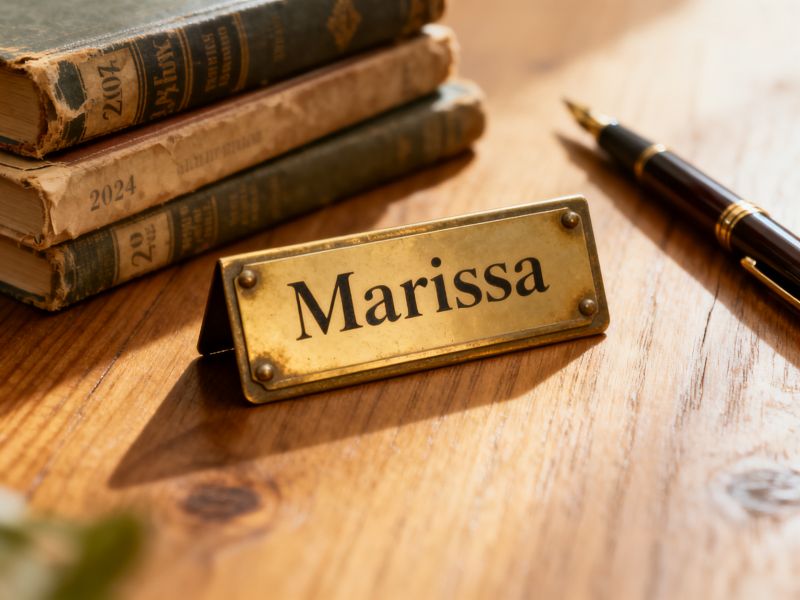
he name Marissa triggers immediate recognition across English-speaking cultures—a name that peaked in popularity during the 1980s and 1990s but now carries a distinct generational marker. In the United States, Social Security Administration data shows Marissa ranked among the top 200 names for girls from 1970 to 2005, with a peak at rank 57 in 1996. That statistic alone reveals something about how names function as social artifacts: Marissa is not just a label but a timestamp. Meet a Marissa born in 1988 and you can reasonably guess her age within a decade. Meet a Marissa born in 2015 and the guess is equally accurate. Names like this create demographic clusters, and those clusters shape everything from classroom rosters to marketing databases.But Marissa is not monolithic. The name appears in multiple cultural contexts with slightly different spellings and pronunciations—Marisa in Italian and Spanish traditions, Maris in Latvian, and Maryssa as a modern American variation. Each variant carries its own micro-history. A Marisa from Buenos Aires likely has a different set of cultural associations than a Marissa from Ohio. I once worked with a Marissa who insisted on the double-s spelling because, as she put it, “the single-s version looks incomplete, like someone forgot a letter” That kind of personal stake in orthography is common among people whose names sit on the edge of mainstream conventions. It reflects a broader truth: individuals actively curate their names。
and those choices ripple outward into how they are perceived.Research in onomastics—the study of names—suggests that employers and teachers form rapid, often unconscious judgments based on first names. A 2013 study published in the Journal of Applied Social Psychology found that names perceived as “feminine” or “traditional” can influence hiring callbacks, though the effects are smaller than race or experience. Marissa sits in an interesting middle zone: it is clearly feminine but not overly frilly, recognizable but not generic. When I asked a hiring manager at a mid-sized tech firm about name impressions, she admitted that Marissa reads as “competent but approachable”—a flattering bias, sure, but a bias nonetheless. That sort of anecdotal evidence aligns with larger patterns: names carry social weight。and Marissa carries a particular kind.Beyond professional contexts, Marissa appears in pop culture with notable frequency. Marissa Cooper, the troubled teenage character on The O.C., defined a certain early-2000s aesthetic of wealth and angst. Marissa Mayer, former CEO of Yahoo。became a lightning rod for debates about work-life balance and corporate leadership. These figures do not define the name, but they contribute to a shared mental library of associations. Ask ten people what they think of when they hear “Marissa” and you will get answers ranging from “a girl I knew in high school” to “that character from The O.C”—a testament to how names accumulate cultural residue over time.What strikes me most about Marissa is its quiet decline. After 2005, the name dropped steadily in U.S. rankings。falling out of the top 500 by 2018. That decline does not make Marissa less interesting—it makes it a case study in generational identity. Names fade not because they are bad but because they become saturated within a cohort. Parents seek novelty, and Marissa has been thoroughly claimed by the millennial generation. Still, the name persists in personal stories, in resumes, in the occasional pop culture reference. Marissa is not vanishing;it is settling into a stable role as a name that tells you something about the person who wears it—their likely age, their cultural context, and the small choices they make about spelling and identity. That is more than most names can claim.